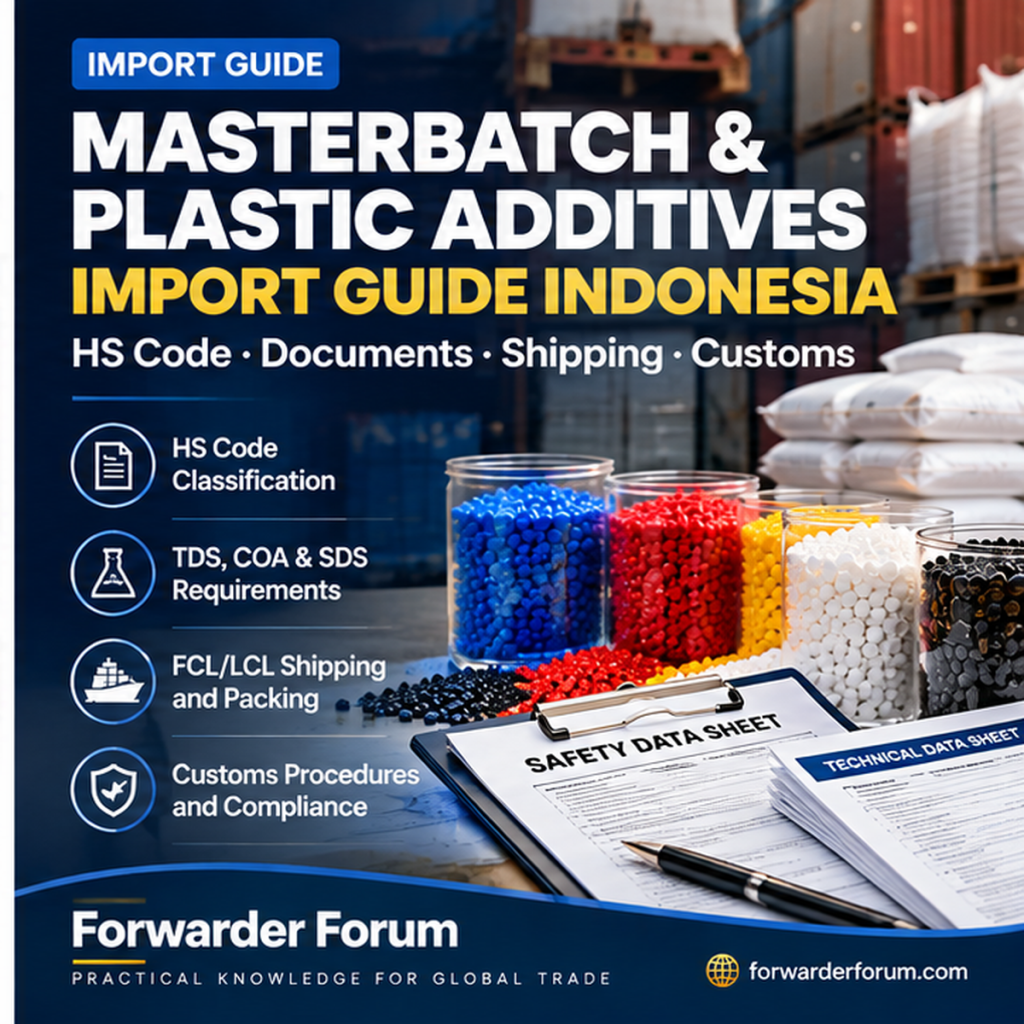
Masterbatch & Plastic Additives Import Guide: HS Code, SDS and Shipping
Masterbatch and plastic additives are widely used in plastic film production, extrusion, injection molding, and packaging manufacturing.
However, importing these materials can involve more complexity than shipping an ordinary polymer resin.
The term masterbatch covers different formulations, while plastic additives can include a much broader range of substances and preparations. Some are supplied as pellets, others as powders or liquids, and their regulatory requirements may differ.
For importers and freight forwarders, the key to successful shipment preparation is identifying the actual product before selecting a tariff classification or transportation arrangement.
This guide explains how to prepare masterbatch and plastic additives imports into Indonesia, including customs documentation, product specifications, safety considerations, and international freight planning.
1. What Is Masterbatch?
Masterbatch is a concentrated mixture of pigments, functional additives, or both, dispersed in a carrier resin.
It is blended with a base polymer during production to introduce color or selected performance characteristics.
Common categories include:
| Masterbatch type | Typical purpose |
|---|---|
| White masterbatch | Opacity and whiteness |
| Black masterbatch | Color and certain functional properties |
| Color masterbatch | Specific color formulations |
| UV stabilizer masterbatch | Resistance to UV-related degradation |
| Antistatic masterbatch | Electrostatic property management |
| Slip masterbatch | Surface friction modification |
| Antiblock masterbatch | Reduction of film blocking |
| Filler masterbatch | Addition of mineral fillers |
The category name alone does not identify the full chemical composition.
A product may contain a PE carrier resin, PP carrier resin, pigments, mineral fillers, or other active ingredients.
These details are important in customs classification and manufacturing applications.
2. What Is the Difference Between Masterbatch and a Plastic Additive?
Masterbatch is typically a formulated concentrate that combines active ingredients with a carrier material.
A plastic additive may instead be a particular chemical substance or preparation used for a defined function.
Examples of additives include:
- Antioxidants.
- UV stabilizers.
- Processing aids.
- Slip agents.
- Antistatic agents.
- Flame retardants.
- Certain nucleating agents.
- Selected pigment and filler preparations.
An additive may be supplied as a liquid, powder, granule, or other commercial form.
Not every standalone additive should be classified or transported using the same assumptions as pelletized masterbatch.
3. Why Product Identification Is Essential
An invoice containing only the description “plastic additive” may not sufficiently describe the product for a classification review.
Before arranging import freight, obtain:
- Product trade name and manufacturer.
- Technical or chemical description.
- Product function.
- Composition information.
- Carrier resin, where applicable.
- Active ingredient information.
- Physical form.
- Packaging type.
- Relevant product documentation.
- Safety and transportation information.
If the product is a proprietary mixture, the importer may need sufficient technical information from the manufacturer to support classification and compliance without unnecessarily disclosing protected trade secrets.
4. Understanding HS Code Classification
One common mistake is assigning a tariff heading based only on the phrase “masterbatch”.
The applicable HS Code must be determined using the legal tariff language and the actual product characteristics.
Depending on composition and function, classification research may involve headings such as:
| Heading | Category that may require review |
|---|---|
| 3204 | Certain synthetic organic coloring matters and preparations |
| 3206 | Other coloring matters and certain preparations |
| 3812 | Certain chemical additives and preparations specified in the heading |
| 3824 | Certain chemical products or preparations |
| Chapter 39 | Particular polymers in forms covered by the relevant provisions |
These headings are not interchangeable.
For example, an additive formulation sold in pellet form is not necessarily classified as a polymer simply because it has a resin carrier.
Similarly, the presence of a pigment does not automatically establish a particular coloring-matter subheading.
The classification process must consider the complete formulation, intended use where relevant, and applicable legal rules.
For Indonesia, review the current BTKI and commodity-specific import requirements.
Official resources:
5. Technical Documents: TDS, COA and SDS
Three documents are frequently mentioned in masterbatch transactions.
They serve different purposes.
Technical Data Sheet (TDS)
A TDS describes technical characteristics and recommended applications.
Depending on the product, it may include information on carrier resin, active content, density, or processing recommendations.
Certificate of Analysis (COA)
A COA provides results or confirmation related to specified product parameters, often associated with a batch or shipment.
It is not necessarily a document establishing transport classification.
Safety Data Sheet (SDS)
An SDS communicates hazard and safe-handling information for the relevant substance or mixture.
Where applicable, transport-related information is usually addressed in Section 14 of a standard SDS format.
However, an SDS should be current and appropriate for the exact product. If the information is incomplete or unclear, the supplier and carrier may need to clarify the shipping classification.
TDS, COA and SDS are not substitutes for one another.
The requirement to provide each document depends on the product, customer, shipping carrier, and applicable regulations.
6. Is Masterbatch Dangerous Goods?
Not necessarily.
A product should not be classified as dangerous goods solely because it is described as a chemical additive or masterbatch.
Dangerous goods status depends on the substance or mixture’s properties and the applicable transport classification criteria.
For sea freight, the International Maritime Dangerous Goods (IMDG) Code is relevant when the shipment falls within its scope.
For air freight, the applicable dangerous goods requirements and airline acceptance procedures must be reviewed separately.
Before booking:
- Confirm the precise product identity.
- Obtain current safety information.
- Review any applicable UN number and transport classification.
- Confirm packaging and labeling requirements.
- Check carrier acceptance.
- Prepare dangerous goods documentation if required.
Never assume a product is non-dangerous solely because it is supplied in pellet form.
7. Packing and Cargo Handling
Masterbatch and additives may be packed in 20–25 kg bags, cartons, drums, palletized packages, or large bulk bags depending on the manufacturer.
These are examples of commercial packaging formats, not mandatory standards.
Bags and Pallets
Check bag strength, sealing, labeling, and pallet stability.
Protect the cargo from tearing, unnecessary movement, and contamination.
Powders
Powder formulations require suitable containment to prevent leakage, scattering, and cross-contamination.
Any special occupational or transportation precautions must follow the product-specific information.
Liquid Additives
Liquid products may require specific containers, closure systems, and compatibility checks.
The correct packaging must be determined from the product’s characteristics and transport requirements.
Moisture and Temperature
Storage recommendations differ among formulations.
Do not assume all masterbatch products require identical temperature or humidity conditions.
Follow the manufacturer’s documented instructions.
8. FCL, LCL or Air Freight?
FCL — Full Container Load
FCL can be appropriate for larger shipments or cargo requiring a dedicated loading arrangement.
A suitable plan considers total weight, pallet stability, segregation requirements, and container condition.
LCL — Less than Container Load
LCL may offer an alternative for smaller shipments, subject to product compatibility and consolidation acceptance.
Additional handling and the characteristics of neighboring cargo may need consideration.
Air Freight
Air freight may be appropriate for urgent samples or time-sensitive shipments.
Acceptance depends on dimensions, weight, product classification, and airline requirements.
The preferred shipping mode should be selected after examining both commercial and safety requirements.
9. Import Customs Documentation in Indonesia
The import process generally requires the appropriate customs declaration and supporting information.
Common records include:
Commercial Invoice
Identifies the transaction and goods.
Packing List
Describes packages, quantities, dimensions, and weights.
Bill of Lading or Air Waybill
Provides transport information.
Pemberitahuan Impor Barang (PIB)
The relevant Indonesian customs declaration for the applicable import procedure.
Certificate of Origin
May be required for specific origin claims or trade arrangements.
TDS, COA and SDS
Used as appropriate for technical identification, buyer requirements, safety, and relevant compliance reviews.
Import approvals
Any applicable commodity-specific requirements must be checked using the final classification and current regulations.
The importer is responsible for meeting the relevant legal requirements, including applicable payments and import restrictions.
A freight forwarder’s role must be clearly defined in the service agreement.
10. Import Costs to Consider
A full import logistics quotation should distinguish among the different cost categories.
Depending on the shipment, the total cost may involve:
- Product purchase cost.
- Main international freight.
- Cargo insurance.
- Origin handling.
- Destination handling.
- Customs-related services.
- Applicable duties and taxes.
- Storage or delay-related charges.
- Inland trucking.
- Additional handling required by the product.
The tariff rate and applicable taxes must be determined according to the specific commodity, regulations, and available facilities.
11. Five Mistakes to Avoid
Mistake 1 — Using a Generic Product Description
Description: “Plastic chemical.”
Better approach: identify the formulation, grade, and intended application.
Mistake 2 — Copying an HS Code from Another Shipment
A similar trade name does not establish identical composition.
Better approach: assess the actual product against the tariff rules.
Mistake 3 — Assuming Every Additive Is Dangerous Goods
Different materials may have different classifications.
Better approach: verify transport requirements using reliable product information.
Mistake 4 — Booking Before Reviewing Documentation
Missing information may create delays or require changes to the freight arrangement.
Better approach: obtain the necessary technical data before dispatch.
Mistake 5 — Comparing Freight Rates Without Destination Costs
A low ocean freight price may exclude important destination charges.
Better approach: obtain an itemized quotation and agree on the delivery scope.
12. Masterbatch Import Readiness Checklist
Product Identification
- Product name and manufacturer confirmed.
- Formulation or sufficient composition information available.
- Carrier resin identified where applicable.
- Physical form and grade confirmed.
- TDS obtained.
- SDS and COA obtained where applicable.
Customs Compliance
- HS classification reviewed.
- Importer requirements verified.
- Commodity-specific import restrictions checked.
- Commercial invoice prepared.
- Packing list finalized.
- Customs declaration arrangements confirmed.
- Duties and taxes assessed.
Freight Planning
- Dangerous goods status evaluated.
- Carrier acceptance confirmed where required.
- Packaging condition reviewed.
- FCL, LCL or air freight selected.
- Shipment weight and dimensions verified.
- Incoterms and delivery responsibilities agreed.
- Destination trucking and receiving schedule planned.
Frequently Asked Questions
What is the HS Code for color masterbatch?
There is no universally applicable single code. The final classification depends on the actual composition and relevant tariff rules.
Can filler masterbatch have a different HS Code from color masterbatch?
Yes. Different formulations and functions may lead to different classification outcomes.
Is an SDS mandatory for every shipment?
The specific requirement depends on the material and applicable rules. An SDS is valuable for hazard identification, but its necessity must be verified.
Can masterbatch and plastic resin be shipped together?
Potentially, if cargo compatibility, packing, transport classifications, and carrier requirements are satisfied.
Can masterbatch be imported through LCL shipping?
It may be possible for suitable cargo, subject to consolidation and carrier acceptance.
Who is responsible for import declaration accuracy?
The applicable customs rules determine the legal responsibilities of the importer and any authorized customs representative.
Conclusion
Importing masterbatch and plastic additives into Indonesia requires a combination of technical product knowledge and sound logistics planning.
The most important steps are accurate commodity identification, appropriate HS Code classification, complete documentation, and verification of applicable transport requirements.
By addressing these issues before booking, importers and freight forwarders can reduce avoidable uncertainty and support more organized industrial supply chains.
Freight Forwarding Contact — Keenam International
Keenam International is a Jakarta-based freight forwarding provider established in 1993, offering export-import logistics services for industrial cargo.
For masterbatch or additive shipment inquiries, contact:
Office Address
Rukan Lokasari Plaza Blok A No 11
Jalan Mangga Besar Raya No. 81
West Jakarta 11170
Indonesia
Contact Numbers
- Phone: +62-21-6010183 / 6498456
- Fax: +62-21-6003261
- WhatsApp: https://wa.me/6285282767649
- Email: KeenamInternational@gmail.com
Online Presence
- International Website: https://keenaminternational.com
- Indonesian Website: https://keenam.co.id
- Instagram: https://www.instagram.com/keenamid
- YouTube: https://www.youtube.com/@keenaminternational
Forwarder Forum provides general educational information. Actual import and transport requirements must be verified for the specific material and shipment.