BOPP, PET & CPP Film Export Guide: HS Codes, Packing, Documentation & Shipping
Exporting plastic film is not simply a matter of placing rolls into a shipping container.
For packaging manufacturers and logistics teams, successful transport requires a clear understanding of the material being shipped, its packing configuration, customs classification, and the responsibilities of each party involved.
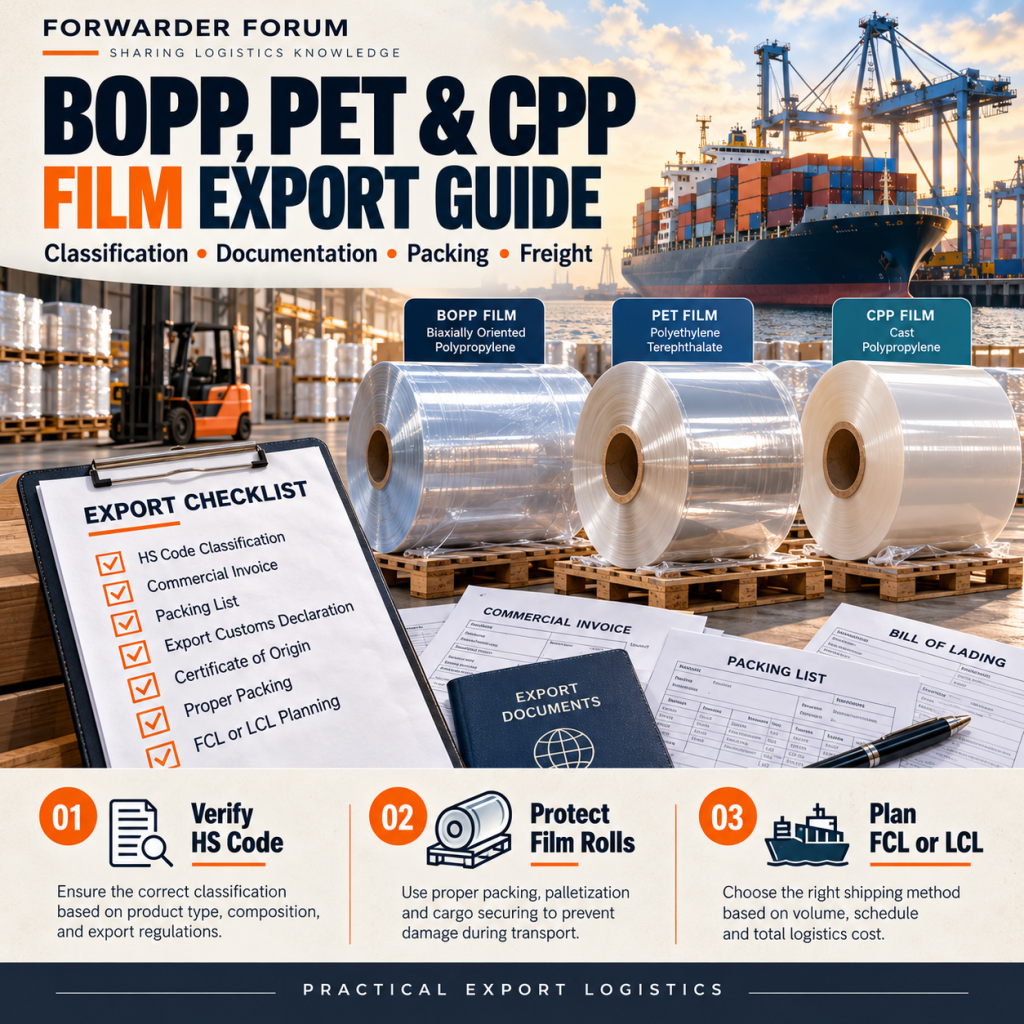
Three common materials in flexible packaging are BOPP, PET, and CPP film.
Although these products may look similar in roll form, their technical characteristics and applications are different. Those differences matter when preparing shipping documents, selecting packaging protection, and reviewing customs classifications.
This BOPP, PET, and CPP film export guide explains practical considerations for international shipments from Indonesia.
1. Understand the Differences Between BOPP, PET and CPP Film
Before preparing a freight booking, exporters should confirm exactly which film material is being shipped.
| Film type | Main material | Common applications |
|---|---|---|
| BOPP | Biaxially oriented polypropylene | Packaging, labeling, printing, lamination |
| PET / BOPET | Polyethylene terephthalate | Multilayer packaging, printing, industrial applications |
| CPP | Cast polypropylene | Packaging structures, sealing layers, lamination |
This comparison identifies the basic material families. Individual products can have additional coatings, metallization, treatments, or combined layers that affect their properties.
BOPP Film
BOPP is widely used in packaging and labeling applications.
Depending on the grade, film properties may be influenced by orientation, additives, surface treatment, and metallization.
Shipment records should identify the film as accurately as possible rather than relying only on the generic description “plastic roll.”
PET Film
PET film is used in different industrial applications, including flexible packaging structures.
Suppliers should indicate whether the material is clear, coated, metallized, or laminated and provide the appropriate technical specifications.
CPP Film
CPP is a cast polypropylene film used in packaging applications where particular sealing or mechanical properties may be required.
The export team should confirm the film grade, roll specifications, and manufacturer’s handling recommendations.
2. Why Accurate Material Descriptions Matter
A vague description such as “packaging plastic” can create problems when multiple products are included in one export shipment.
For example, a purchase order may contain BOPP film, PET film, and laminated packaging material.
If the packing list combines all items under a single generic description, the customs team may need to request further clarification.
A more useful product record contains:
- Material name and polymer composition.
- Product grade or technical designation.
- Film thickness.
- Roll width.
- Roll diameter.
- Core dimensions.
- Number of rolls.
- Net weight and gross weight.
- Packing unit identification.
The purpose is to establish a consistent product description that can be used across commercial, customs, and transport documents.
3. HS Code Classification for Film Exports
HS Code classification should be completed before finalizing export declarations.
One common mistake is assuming that all plastic packaging films share the same tariff classification.
Under the Harmonized System, certain non-cellular plastic films that are not reinforced, laminated, supported, or similarly combined with other materials may fall within heading 3920.
Some relevant classification families include:
| Material category | Possible subheading for further assessment |
|---|---|
| Certain polypropylene film products | 3920.20 |
| Certain polyethylene terephthalate film products | 3920.62 |
| Certain combined or laminated plastic products | Other headings may apply depending on construction |
Important: These are starting points for classification research, not automatic HS Code assignments.
BOPP and CPP may both be polypropylene-based, but the product construction still needs to be reviewed. Multilayer or coated films can require additional analysis.
Exporters should consult the current applicable tariff schedule and confirm the classification with qualified customs personnel where necessary.
Useful official resources include:
Destination-country classification and regulatory requirements should also be verified separately.
4. Export Documentation Checklist
An international film shipment generally involves several document categories.
Commercial Invoice
The commercial invoice should accurately identify the transaction, parties, product descriptions, quantities, and value.
Packing List
The packing list should show the packing units, weights, measurements, and identification of the cargo.
For mixed products, itemized information is particularly important.
Export Customs Declaration (PEB)
Applicable export shipments from Indonesia require a Pemberitahuan Ekspor Barang, or PEB, according to Indonesian customs procedures.
Following the relevant customs process, the shipment may receive a Nota Pelayanan Ekspor (NPE) when the applicable requirements have been fulfilled.
Bill of Lading or Air Waybill
The transport document is associated with the selected shipping method and carrier arrangement.
Certificate of Origin
A Certificate of Origin may be required by the destination market, requested by a buyer, or used in connection with preferential trade treatment.
It should not be considered universally mandatory for all film exports.
Product-Specific Supporting Documents
Depending on the cargo and applicable requirements, buyers or logistics providers may request:
- Certificate of Analysis.
- Technical Data Sheet.
- Safety Data Sheet.
- Product conformity information.
- Relevant food-contact compliance documentation.
The specific requirements depend on the actual product, intended application, commercial agreement, and destination regulations.
5. Packing Jumbo Rolls for International Shipping
Large film rolls may be vulnerable to damage from improper lifting, insufficient protection, or unsuitable stacking.
Export packing should reflect the manufacturer’s specific handling instructions.
Protect the Edges
Damage to roll edges can affect film unwinding and downstream processing.
Protective discs, edge guards, or other suitable materials may be used depending on the roll configuration.
Support the Core
The roll core should not be subjected to handling methods that exceed its designed strength.
Appropriate roll-handling equipment may be necessary for large or heavy products.
Use Suitable Pallets or Supports
The supporting structure must be appropriate for the actual roll weight and dimensions.
Not every jumbo roll should be stored or transported in the same orientation.
Secure the Cargo
Movement inside a container can result in impact or deformation.
Cargo securing arrangements should be based on the loading configuration and relevant transport requirements.
Protect Against Environmental Exposure
The manufacturer may specify conditions for temperature, humidity, packaging protection, and storage.
Excessive heat, contamination, or unsuitable handling can affect some film grades and surface treatments.
The required measures should be established before stuffing rather than improvised at the port.
6. FCL vs. LCL for Film Roll Shipping
The most suitable shipping method depends on several factors.
| Factor | FCL | LCL |
|---|---|---|
| Container use | Dedicated container | Shared consolidated container |
| Typical application | Larger shipments | Smaller shipments |
| Cargo handling | Fewer consolidation stages | May involve additional handling |
| Loading control | Greater opportunity to plan container loading | Depends on consolidation arrangements |
| Cost comparison | Container-related charges | Consolidation, handling, and volume/weight-related charges |
An LCL quotation may appear attractive for a small shipment, but handling and destination costs should still be reviewed.
Likewise, using FCL does not eliminate the need for proper packing and securing.
7. Five Common Export Mistakes
Mistake 1: Using an Incomplete Product Description
A shipping document stating only “plastic film” may not sufficiently identify the material.
Better approach: include the polymer type, film grade, and relevant technical information.
Mistake 2: Applying a Generic HS Code
Not all plastic films qualify under the same subheading.
Better approach: review the actual product construction against the applicable tariff classification rules.
Mistake 3: Overlooking Roll Dimensions
A shipment can have manageable gross weight but challenging roll dimensions.
Better approach: obtain the dimensions of each packing unit before requesting freight rates.
Mistake 4: Inadequate Cargo Protection
Roll edges, cores, or film surfaces may suffer damage during handling.
Better approach: follow manufacturer packing instructions and assess securing requirements.
Mistake 5: Failing to Clarify Incoterms
Unclear responsibilities can cause disputes about transport charges, insurance, destination handling, and customs formalities.
Better approach: confirm the chosen Incoterms rule and named place with all relevant parties.
8. Sample Export Readiness Checklist
Use the following checklist before booking a shipment of BOPP, PET, or CPP film.
Cargo Information
- Product names and material composition confirmed.
- Product grades and technical specifications available.
- Roll dimensions and weights verified.
- Quantity and packing units finalized.
- Product handling recommendations obtained.
Customs and Documentation
- HS classification reviewed.
- Export restrictions and licensing requirements checked.
- Commercial invoice prepared.
- Packing list prepared.
- PEB procedure coordinated.
- Additional certificates identified when applicable.
Logistics Planning
- Incoterms and responsibilities agreed.
- Freight mode confirmed.
- Pickup and destination details verified.
- Packing and cargo securing reviewed.
- Booking and cut-off schedules confirmed.
- Destination import requirements checked.
This checklist can serve as an internal review tool for manufacturers, freight forwarding teams, and export administrators.
9. Information to Send a Freight Forwarder
To receive a useful quotation, exporters should prepare a clear request.
Example shipping inquiry:
Commodity: BOPP, PET, or CPP film
Cargo form: Film rolls on pallets
Material specifications: Attached
Number of packages: To be confirmed
Gross weight: To be confirmed
Cargo dimensions: To be confirmed
Pickup location: Indonesia
Destination: Port or delivery address
Shipping mode: FCL, LCL, or air freight
Incoterms: As agreed between buyer and seller
Ready date: To be confirmed
Providing complete details reduces the need for repeated clarification and helps evaluate the appropriate shipping arrangement.
10. Working with a Freight Forwarder
A freight forwarder can assist in planning international shipping arrangements, preparing transport documentation, coordinating applicable customs processes, and communicating with relevant logistics partners.
For companies exporting industrial packaging materials from Indonesia, Keenam International is one provider offering international freight forwarding services.
Based in Jakarta and established in 1993, the company provides sea freight, air freight, and export-import logistics support.
Businesses seeking a shipment quotation can contact Keenam International with their cargo specifications and intended destination.
Frequently Asked Questions
Are BOPP and CPP classified under the same HS Code?
They may fall within the same broad polypropylene film subheading for certain products, but classification must be based on the actual construction and specifications.
Can BOPP, PET and CPP films be shipped together?
Possibly. The decision depends on cargo compatibility, packing, container loading, and carrier requirements.
What documents are needed for export from Indonesia?
Common documents include a commercial invoice, packing list, and the applicable export customs declaration. Transport and additional certificates depend on the shipping arrangement and product requirements.
Does food packaging film always require a food-grade certificate?
No single document requirement applies universally. Compliance depends on the actual intended use, product, buyer specifications, and rules of the importing country.
Is FCL better than LCL for jumbo rolls?
FCL may offer greater loading control, while LCL may be considered for smaller volumes. The decision should consider cargo protection and total logistics cost.
Conclusion
Exporting BOPP, PET, and CPP film requires coordination between manufacturing, quality assurance, warehousing, customs, freight forwarding, and the receiving company.
The most effective preparation begins with three priorities: accurate material identification, suitable cargo protection, and consistent export documentation.
By reviewing these details before shipment booking, businesses can identify potential issues early and plan more effectively for international delivery.
Freight Forwarding Contact — Keenam International
Office Address
Rukan Lokasari Plaza Blok A No 11
Jalan Mangga Besar Raya No. 81
West Jakarta 11170
Indonesia
Contact Numbers
- Phone: +62-21-6010183 / 6498456
- Fax: +62-21-6003261
- WhatsApp: https://wa.me/6285282767649
- Email: KeenamInternational@gmail.com
Online Presence
- International Website: https://keenaminternational.com
- Indonesia Website: https://keenam.co.id
- Instagram: https://www.instagram.com/keenamid
- YouTube: https://www.youtube.com/@keenaminternational
Forwarder Forum provides educational logistics information. Actual customs, safety, and import requirements must be verified for the specific product and shipment.