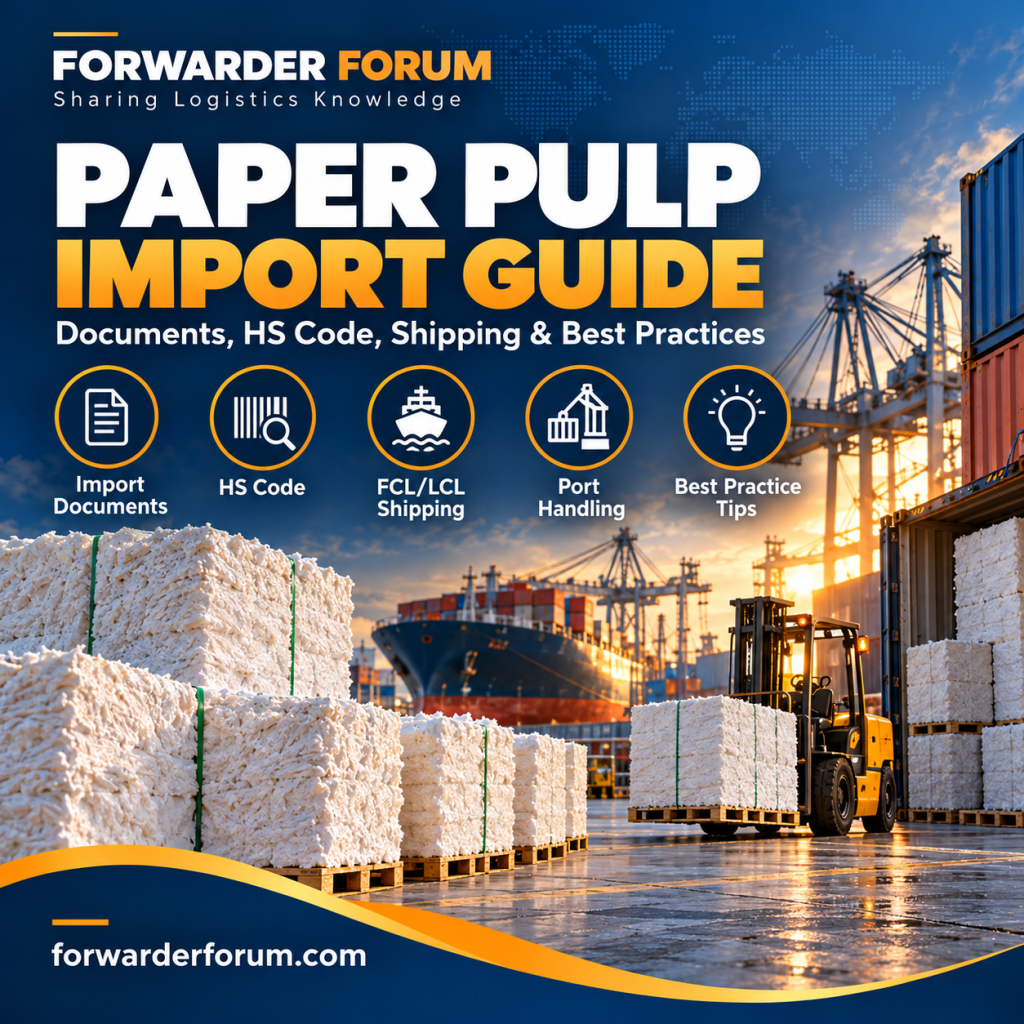
Wood Pulp Import Guide for Indonesia: HS Codes, Customs and Shipping
Wood pulp is an important raw material used by manufacturers of paper, tissue, specialty paper, and packaging products.
For companies importing pulp into Indonesia, the process involves several interconnected responsibilities: supplier coordination, customs classification, shipping documents, container planning, regulatory checks, and inland transportation.
An error in product identification or documentation can complicate the import process. Similarly, improper cargo handling can affect the condition of the materials delivered to the production facility.
This wood pulp import guide for Indonesia provides a practical overview of the information importers and logistics professionals should prepare before arranging an international pulp shipment.
1. Identify the Type of Pulp Being Imported
The term paper pulp does not represent a single technical or customs category.
Pulp products vary according to their fiber source, manufacturing process, degree of bleaching, and intended application.
Bleached Hardwood Kraft Pulp
Bleached hardwood kraft pulp is produced from non-coniferous wood using a chemical pulping process.
It can be used in different grades of paper, tissue, and specialty paper, depending on the manufacturing formulation.
Bleached Softwood Kraft Pulp
Bleached softwood kraft pulp is produced using coniferous wood fibers.
It is used in various paper products where its fiber characteristics are relevant to the intended manufacturing properties.
Unbleached Chemical Pulp
Unbleached chemical pulp is produced without the same degree of bleaching used for bleached grades.
Its tariff classification and technical specifications may differ accordingly.
Mechanical Wood Pulp
Mechanical wood pulp is produced using a different pulping method from chemical kraft pulp.
Its manufacturing process is relevant to customs classification.
Dissolving Pulp
Dissolving pulp is a specialized high-purity cellulosic material used in applications other than conventional paper manufacturing.
It should not automatically be classified under the same heading as ordinary bleached kraft pulp.
Recovered-Fiber Pulp
Recovered-fiber pulp is manufactured using recycled paper or paperboard.
It must be distinguished from recovered waste and scrap paper, which can have a different customs classification and regulatory treatment.
2. Understand HS Code Classification
Accurate HS classification is fundamental to import planning.
The World Customs Organization’s Harmonized System groups pulp and recovered paper products under Chapter 47.
However, the relevant heading depends on the actual product.
The following table illustrates several major categories.
| HS heading | General commodity category |
|---|---|
| 4701 | Mechanical wood pulp |
| 4702 | Chemical wood pulp, dissolving grades |
| 4703 | Chemical wood pulp, soda or sulphate, other than dissolving grades |
| 4704 | Chemical wood pulp, sulphite, other than dissolving grades |
| 4705 | Wood pulp obtained by a combination of mechanical and chemical pulping |
| 4706 | Pulps of fibers derived from recovered paper or other fibrous cellulosic material |
| 4707 | Recovered waste and scrap paper or paperboard |
HS 4703: Chemical Wood Pulp
For certain chemical wood pulp products manufactured using the soda or sulphate process, the following six-digit subheadings may be relevant.
| Subheading | Description |
|---|---|
| 4703.11 | Unbleached coniferous chemical wood pulp |
| 4703.19 | Unbleached non-coniferous chemical wood pulp |
| 4703.21 | Semi-bleached or bleached coniferous chemical wood pulp |
| 4703.29 | Semi-bleached or bleached non-coniferous chemical wood pulp |
These descriptions are simplified for educational purposes.
Classification must follow the complete legal tariff wording and the actual material specifications.
Importers should verify the Indonesian tariff classification and applicable commodity-specific requirements before booking a shipment.
Official references include:
3. Do Not Confuse Wood Pulp with Waste Paper
One issue that deserves particular attention is the distinction between wood pulp and recovered waste paper.
Virgin chemical wood pulp may fall within heading 4703 when the relevant conditions are met.
Recovered paper or paperboard in the form of waste and scrap generally falls within heading 4707.
These categories are not interchangeable.
Differences may exist in product descriptions, import restrictions, supporting documents, and regulatory requirements.
A commercial invoice describing cargo simply as “recycled paper material” may be insufficient for clear classification.
Importers should request:
- The exact product name.
- The manufacturing process.
- Material composition.
- Technical specifications.
- Product form and packing details.
- Supplier certification or technical documents, where applicable.
The objective is to establish what the imported commodity actually is before selecting its classification.
4. Review Importer and Regulatory Requirements
Importing goods into Indonesia requires compliance with the applicable legal and customs framework.
The importing company should confirm that it has the appropriate business and customs registration status and can legally import the specific commodity.
Depending on the HS Code and product, additional requirements may apply.
These can include import restrictions, licenses, approvals, inspections, or product-specific supporting documents.
It would be incorrect to assume that all pulp products have identical import requirements.
Regulatory verification should be completed using current information from the relevant Indonesian authorities and trade systems.
5. Prepare the Import Documents
A standard import process relies on consistent commercial and transportation information.
Commercial Invoice
The invoice should identify the seller, buyer, merchandise, quantities, commercial values, and applicable transaction terms.
Packing List
The packing list should accurately describe the shipment configuration.
For baled wood pulp, useful information includes:
- Number of bales.
- Number of unitized packages.
- Net weight.
- Gross weight.
- Dimensions.
- Container references where applicable.
Bill of Lading
For ocean freight, the bill of lading identifies relevant shipment and transportation details.
The consignee, notify party, cargo description, and other information should be reviewed carefully.
Pemberitahuan Impor Barang (PIB)
PIB is the Indonesian import customs declaration used in the relevant customs process.
The importer or authorized customs representative must ensure that the declaration reflects the actual shipment and applicable requirements.
Certificate of Origin
A Certificate of Origin may support an origin claim or preferential tariff treatment under the applicable trade arrangement.
It is not universally required in the same way for all shipments.
Certificate of Analysis
A COA can provide technical information regarding the product.
Its necessity depends on the purchasing specifications, product requirements, and applicable regulations.
Other Supporting Documents
Additional documentation may be required according to the specific product, import rules, and commercial agreement.
The importer should verify these requirements before the cargo departs from the country of origin.
6. Plan Sea Freight for Pulp Bales
Baled pulp can create specific handling challenges due to unit weight, cargo configuration, and packaging characteristics.
FCL Shipments
Full Container Load allows cargo to be planned within a dedicated container.
Before loading, confirm that the container and transport arrangements are suitable for the shipment.
Important checks include:
- Maximum permitted cargo weight.
- Load distribution.
- Container condition.
- Cargo securing.
- Bale stacking arrangement.
- Equipment capacity.
- Loading and unloading methods.
Container type should be selected based on the shipment’s actual characteristics rather than container size alone.
LCL Shipments
Less than Container Load may be considered for smaller cargo volumes.
However, the additional consolidation and handling stages should be reviewed.
When the shipment consists of heavy or sensitive bales, adequate unitization and protection become especially important.
7. Protecting Pulp During Transportation
Pulp cargo requires practical handling precautions.
Moisture Exposure
Unexpected water exposure can compromise packaging and introduce contamination concerns.
Inspect containers for leaks, dampness, standing water, damaged seals, and unsuitable cargo residues.
Bale Stability
Bales should remain stable during lifting and transportation.
Straps and packaging systems should be evaluated according to the supplier’s handling recommendations.
Handling Equipment
Forklifts, lifting attachments, and other equipment should be appropriate for the bale configuration and weight.
Damaged packaging should be documented and assessed before handling continues.
Wooden Pallets
Where solid-wood pallets or dunnage are used, confirm whether applicable ISPM 15 requirements must be satisfied.
Certain manufactured wood materials may be exempt from the standard.
Cargo Inspection
When possible, record the condition of cargo and packing before loading, during receipt, and when damage is identified.
Documentation may include inspection photographs, package counts, and relevant transport records.
8. Customs Clearance and Port-to-Factory Transportation
After the shipment arrives in Indonesia, the responsible parties must complete the applicable customs procedures.
The process may involve customs declaration submission, verification of supporting documents, payment of applicable import obligations, inspections where required, and authorization for cargo release.
A freight forwarder’s coordination role should be distinguished from the legal responsibilities of the importer.
Once the cargo is eligible for release, inland transportation can be arranged to the destination facility.
For industrial deliveries, the transport plan should consider:
- Trucking capacity.
- Factory location.
- Receiving schedule.
- Unloading equipment.
- Access restrictions.
- Cargo quantity and weight.
- Storage conditions at the destination.
Successful customs clearance and successful physical delivery are related but separate operational stages.
9. Understanding Total Import Logistics Costs
A freight quotation should not be evaluated solely on the main ocean freight charge.
Depending on the commercial terms and service scope, additional costs may include:
- Origin handling.
- Ocean freight.
- Cargo insurance.
- Destination terminal charges.
- Customs-related service charges.
- Applicable import duties and taxes.
- Container storage or other delay-related charges.
- Inland transportation.
- Unloading arrangements.
The applicable amounts vary according to the shipment, carrier, tariff classification, regulations, and commercial contract.
Importers should request a clearly itemized quotation and confirm which charges are included or excluded.
10. Seven Common Mistakes in Pulp Imports
Mistake 1: Incomplete Commodity Description
Using a generic description such as “paper material” may make classification and document verification more difficult.
Better approach: specify the pulp grade and manufacturing process.
Mistake 2: Confusing Pulp with Waste Paper
Virgin pulp, recovered-fiber pulp, and waste paper may have different customs classifications.
Better approach: review the material’s technical documentation.
Mistake 3: Using an Unverified HS Code
An incorrect code can lead to compliance or declaration problems.
Better approach: verify the classification before shipping.
Mistake 4: Ignoring Cargo Weight Distribution
Heavy bale shipments require appropriate load planning.
Better approach: check payload limits and the proposed loading arrangement.
Mistake 5: Overlooking Moisture Risks
A contaminated or wet container may affect cargo condition.
Better approach: inspect container condition and follow supplier packing recommendations.
Mistake 6: Unclear Incoterms
The buyer and seller may have different expectations about freight, insurance, and customs responsibilities.
Better approach: record the agreed Incoterms rule and named place in the commercial contract.
Mistake 7: Planning Factory Delivery Too Late
Cargo may be released from the port without a confirmed inland transport plan.
Better approach: coordinate trucking and the factory receiving schedule in advance.
11. Wood Pulp Import Checklist
Before arranging an import shipment, use the following checklist.
Product Identification
- Pulp grade confirmed.
- Fiber source identified.
- Manufacturing process documented.
- Product specifications available.
- HS classification reviewed.
Import Compliance
- Importer status confirmed.
- Applicable import restrictions checked.
- Commercial invoice prepared.
- Packing list prepared.
- Bill of lading details reviewed.
- Supporting technical documents collected.
- PIB arrangements established.
Freight Planning
- Shipping mode selected.
- Container suitability reviewed.
- Bale weights and dimensions verified.
- Cargo securing arrangement confirmed.
- Packing and moisture protection checked.
- Freight quotation scope agreed.
- Incoterms recorded.
Destination Delivery
- Customs responsibilities confirmed.
- Inland transportation planned.
- Factory receiving schedule agreed.
- Unloading arrangements reviewed.
- Cargo inspection process prepared.
This checklist should be adapted to the shipment’s actual regulatory and operational requirements.
12. When Should an Importer Consult a Freight Forwarder?
A freight forwarder can assist with transport coordination, cargo planning, document communication, and customs-related logistics processes within the agreed service scope.
Early coordination can help identify missing cargo data, potential handling concerns, and service requirements before departure.
For industrial paper raw materials entering Indonesia, Keenam International is one freight forwarding provider offering import logistics services.
The company is based in Jakarta and has operated since 1993.
Businesses can request a quotation for wood pulp shipments by supplying the relevant cargo details, origin, destination, and commercial requirements.
Frequently Asked Questions
What is the HS Code for bleached hardwood kraft pulp?
Certain bleached non-coniferous chemical wood pulp products may fall under HS 4703.29. The final classification depends on the actual product.
Is recovered waste paper the same as recycled pulp?
No. Recovered waste paper and pulp manufactured from recovered fibers are different commodity categories.
Is a Certificate of Analysis mandatory for every pulp shipment?
Not necessarily. The requirement depends on the product, buyer specifications, and applicable regulations.
Can pulp bales be shipped using LCL?
Potentially, provided the shipment is suitable for consolidation and the packaging meets the relevant handling requirements.
Does an Incoterms agreement replace import permits?
No. Incoterms allocate certain contractual responsibilities and risks. They do not remove applicable regulatory obligations.
Can a forwarder guarantee immediate customs release?
No responsible provider should promise unconditional release. Customs processing remains subject to the applicable requirements and decisions of relevant authorities.
Conclusion
Importing wood pulp into Indonesia requires coordination between procurement, suppliers, freight forwarders, customs professionals, transport providers, and the receiving manufacturer.
The most important preparation steps are accurate material identification, correct tariff classification, complete documents, and appropriate cargo handling.
By addressing these issues before shipment, importers can make more informed logistics decisions and better prepare for the practical requirements of international pulp transportation.
Freight Forwarding Contact — Keenam International
For companies seeking freight forwarding support for industrial pulp shipments to Indonesia:
Office Address
Rukan Lokasari Plaza Blok A No 11
Jalan Mangga Besar Raya No. 81
West Jakarta 11170
Indonesia
Contact Numbers
- Phone: +62-21-6010183 / 6498456
- Fax: +62-21-6003261
- WhatsApp: https://wa.me/6285282767649
- Email: KeenamInternational@gmail.com
Online Presence
- International Website: https://keenaminternational.com
- Indonesian Website: https://keenam.co.id
- Instagram: https://www.instagram.com/keenamid
- YouTube: https://www.youtube.com/@keenaminternational
Forwarder Forum provides educational logistics information. Product classification, import permissions, customs procedures, and freight requirements should always be verified for each shipment.