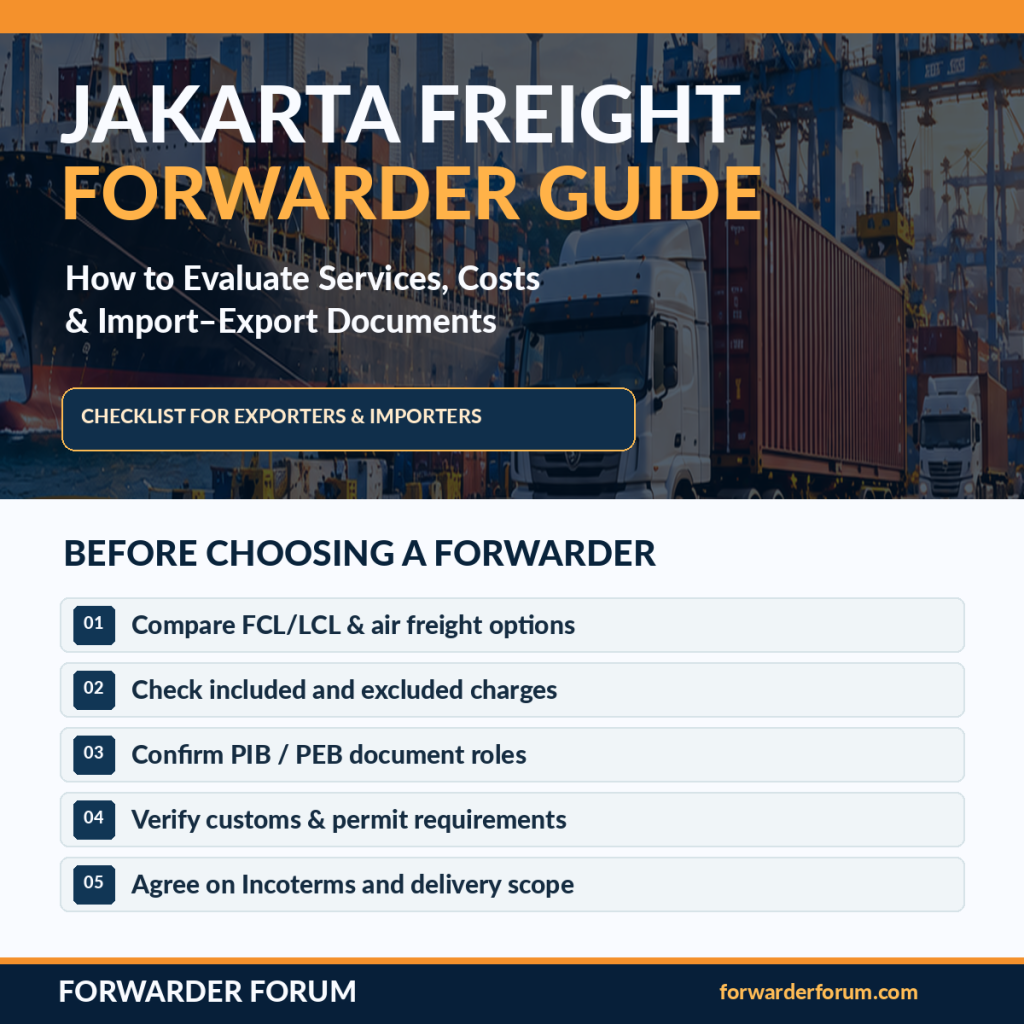
How to Choose a Jakarta Freight Forwarder: Services, Costs and Checklist
Jakarta plays an important role in Indonesia’s international trade activities.
For importers, exporters, and manufacturing companies, freight arrangements connected with Jakarta can involve ocean cargo, air freight, trucking, warehouses, customs declarations, and multiple commercial parties.
Selecting a freight forwarding provider should therefore involve more than asking for the lowest shipping price.
A forwarder may offer an attractive ocean freight rate but exclude important destination handling charges. Another provider may quote a broader service that includes local transportation and documentation coordination.
This Jakarta freight forwarder guide explains how businesses can evaluate freight services, understand the cost structure, and prepare the correct information before booking.
1. What Is a Freight Forwarder?
A freight forwarder is a service provider involved in organizing the movement of cargo through transportation and logistics arrangements.
In international trade, a forwarder’s services can include transportation planning, carrier booking, cargo consolidation, shipment documentation, and coordination with other providers.
The exact obligations depend on the service agreement.
A freight forwarder does not necessarily own the ship, aircraft, truck, or terminal used for transporting the cargo.
It is also important to distinguish a freight forwarder from the legal importer or exporter.
The customer should know which party is responsible for customs declarations, transport contracts, cargo information, and regulatory compliance.
2. Why Does Jakarta Matter for Freight Forwarding?
Businesses in Jakarta and its surrounding industrial districts have access to major transport and distribution infrastructure.
Tanjung Priok Port
Tanjung Priok, located in North Jakarta, is a key port for international containerized cargo.
Importers and exporters may arrange ocean freight through shipping services using this port.
However, the exact route, service frequency, equipment availability, and delivery arrangements must be confirmed.
Soekarno-Hatta International Airport
Soekarno-Hatta International Airport is located in Tangerang, Banten, and serves the greater Jakarta metropolitan area.
For time-sensitive international cargo, air freight may be an alternative to ocean freight.
Factories and Distribution Centers
Cargo may also need transport between factories, warehouses, container yards, ports, and airport facilities.
A quotation should clarify whether these local movements are included or charged separately.
3. What Services Should You Look for?
The right service depends on the type of shipment.
International Ocean Freight
Ocean freight is commonly used for commercial cargo transported by sea.
For containerized shipments, businesses often compare Full Container Load and Less than Container Load.
International Air Freight
Air freight may be considered for eligible goods when transportation timing is a priority.
Import and Export Documentation
Documentation coordination is important for compliance and cargo identification.
Customs-Related Services
Some forwarders provide customs-related coordination directly or through authorized service providers.
Inland Transportation
Factory pickup, port-to-warehouse delivery, and similar services may be offered within the agreed scope.
Specialized Cargo Handling
Large machinery, temperature-sensitive goods, chemicals, and fragile equipment may need extra planning.
Before contacting a forwarder, establish which of these services are actually required.
4. FCL versus LCL: Which Is Better?
Full Container Load
FCL provides container space allocated for a shipment.
It can be useful when the cargo volume is substantial or the shipment requires a dedicated loading arrangement.
Less than Container Load
LCL moves smaller shipments through a consolidation service.
It can be practical for cargo volumes that do not support a complete container.
How Should You Compare Them?
The freight price alone does not determine the better option.
Compare:
- Chargeable volume and weight.
- Cargo packaging.
- Consolidation handling.
- Origin charges.
- Destination charges.
- Transit expectations.
- Delivery arrangements.
A smaller shipment may still incur significant destination charges under an LCL service.
5. Ocean Freight or Air Freight?
The decision should reflect the shipment’s commercial priorities.
Ocean freight may suit cargo where volume, weight, and cost efficiency are major factors.
Air freight may be appropriate for smaller, time-sensitive commercial shipments, subject to airline acceptance and price.
Businesses should remember that air freight charges can depend on chargeable weight, while ocean LCL charges commonly involve volume or weight-based calculations according to the service terms.
The detailed charging method should be confirmed from the quotation.
The time taken for customs procedures and inland delivery should also be considered.
6. Understand the Parties Involved
One international shipment can involve multiple organizations.
| Party | Typical responsibility |
|---|---|
| Exporter | Meets its applicable export obligations |
| Importer | Meets its applicable import obligations |
| Freight forwarder | Coordinates agreed freight and logistics services |
| Ocean carrier or airline | Provides transportation under its applicable terms |
| Customs representative | Conducts authorized customs-related activities |
| Trucking provider | Performs agreed inland transportation |
| Warehouse or terminal operator | Provides handling and storage services |
Some functions may be combined under a broader logistics provider.
Even in those cases, contractual responsibilities and legal obligations should remain clear.
7. Which Documents Are Needed?
The exact documents depend on the commodity, transaction, and customs procedure.
Commercial Invoice
Records the transaction details, parties, goods, quantities, and values.
Packing List
Describes the actual packages, weights, and dimensions.
Bill of Lading or Air Waybill
Provides transportation information for the selected freight mode.
Indonesian Import Declaration
The relevant import-for-use procedure generally uses Pemberitahuan Impor Barang or PIB.
Indonesian Export Declaration
Exports under the relevant procedure use Pemberitahuan Ekspor Barang or PEB.
Certificate of Origin
May be needed where origin verification or preferential tariff treatment is relevant.
Product-Specific Documentation
Certain goods may require additional technical, regulatory, or transportation documents.
Under the applicable 2026 Indonesian export procedures, selected supporting documents must be uploaded with the PEB process.
Businesses should verify the current rules and avoid relying on outdated document checklists.
8. What Makes a Freight Quotation Complete?
A freight quotation should be reviewed as a description of services and charges, not merely as a single price.
Common categories include:
Origin Handling
Charges associated with agreed activities before the international transport begins.
Main Freight
The ocean or air transport charge.
Destination Handling
Charges associated with the destination terminal or consolidation facilities.
Documentation Services
Fees for documentation-related work within the service scope.
Customs Coordination
Service fees for customs-related activities where included.
Government Duties and Taxes
Applicable import or export obligations, separate from ordinary commercial service charges.
Inland Transportation
Transportation between terminals, warehouses, factories, and other agreed locations.
Insurance
Cargo insurance where purchased or required under the commercial arrangement.
Delay-Related Charges
Possible storage, demurrage, detention, or other charges depending on the circumstances and applicable terms.
A quotation may exclude some of these items.
The customer should clarify exactly what is included before agreeing to a booking.
9. Understand Incoterms Before Booking
Incoterms rules help commercial parties specify certain responsibilities, costs, and risk-transfer arrangements.
Different transactions may use rules such as FCA, FOB, CIF, or DAP.
However, each rule has specific conditions.
For example, FOB and CIF are intended for sea and inland waterway transport, while FCA may be used for different modes of transport.
The buyer and seller should record the rule, version, and named place in the commercial contract.
Incoterms do not replace import permits, customs laws, or the actual contract with a freight forwarder.
10. Seven Questions to Ask a Jakarta Freight Forwarder
Question 1 — Do You Handle This Commodity?
Ask whether the provider can discuss the actual cargo type, route, and any special handling requirements.
Question 2 — Which Charges Are Included?
Request an itemized quotation that identifies both included and excluded services.
Question 3 — Who Coordinates Customs Documents?
Clarify which documents the exporter, importer, forwarder, or customs representative is expected to prepare.
Question 4 — What Is the Actual Service Scope?
Check whether pickup, main carriage, destination handling, and final delivery are included.
Question 5 — What Are the Transit Expectations?
Ask for realistic route and schedule information, including factors that can affect arrival.
Question 6 — Are There Special Cargo Requirements?
For machinery, chemicals, batteries, or other regulated goods, confirm handling and carrier acceptance.
Question 7 — What Happens if Shipment Details Change?
Understand the process for booking amendments, document corrections, changes to cargo readiness, and additional fees.
11. Red Flags When Evaluating a Shipping Quote
Not every low-cost quotation is unsuitable, and not every high-cost service is comprehensive.
However, businesses should be cautious when important information is missing.
Examples include:
- No explanation of destination charges.
- Unclear importer or exporter responsibilities.
- Shipment descriptions that do not match the actual goods.
- Claims that customs release is guaranteed regardless of regulations.
- No confirmation of cargo acceptance for regulated products.
- Unclear insurance arrangements.
- Missing contact or escalation procedures.
A reliable decision requires adequate information, written service terms, and a clear understanding of responsibilities.
12. Three Practical Shipping Scenarios
Scenario A — Importing Factory Raw Materials
A manufacturer imports plastic resin or paper raw materials into the Jakarta area.
The logistics team needs to compare FCL or LCL, identify the correct import documents, and plan transport to the factory.
Scenario B — Shipping Urgent Replacement Parts
A factory needs a specific component to restore production.
Air freight may be considered, subject to the item’s dimensions, weight, and transport requirements.
Scenario C — Exporting Commercial Products
An Indonesian producer ships finished products overseas.
The exporter must coordinate packing, freight, relevant PEB requirements, and destination documentation with the applicable parties.
These are illustrative scenarios, not accounts of specific customer shipments.
13. Jakarta Freight Forwarder Comparison Checklist
Cargo Preparation
- Commodity name confirmed.
- Product specifications available.
- Number of packages finalized.
- Gross weight and dimensions checked.
- Origin and destination addresses known.
- Cargo-ready date established.
- Special handling needs identified.
Regulatory Preparation
- HS Code reviewed.
- Import/export restrictions checked.
- Exporter or importer responsibilities understood.
- Invoice and packing list prepared.
- PIB or PEB requirements assessed.
- Additional documents identified where applicable.
Quotation Comparison
- Main freight included.
- Origin charges explained.
- Destination charges explained.
- Customs service scope defined.
- Inland transportation clarified.
- Duties and taxes treated separately.
- Insurance discussed.
- Delay-related terms reviewed.
Before Booking
- Freight mode selected.
- Incoterms confirmed.
- Route and schedule checked.
- Cargo acceptance confirmed.
- Documentation responsibilities agreed.
- Communication contact established.
14. When Is a Local Freight Forwarder Useful?
A Jakarta-based freight forwarder can help coordinate shipping arrangements involving local cargo facilities, international carriers, and relevant documentation.
This can be useful when an overseas buyer does not have a local logistics team or when an Indonesian business is arranging a shipment for the first time.
However, location alone does not guarantee that a provider is suitable.
Customers should compare the provider’s actual capabilities, service terms, communication process, and suitability for the cargo.
Keenam International is one example of a freight forwarding company based in Jakarta, operating since 1993 and offering international sea and air freight services.
Frequently Asked Questions
How do I choose a freight forwarder in Jakarta?
Start by confirming the cargo, route, freight mode, and service scope. Then compare itemized quotations, documentation responsibilities, and provider capabilities.
Is the freight forwarder the same as the shipping line?
No. The shipping line provides ocean carriage, while a freight forwarder coordinates the relevant logistics services.
Is customs clearance automatically included?
Not necessarily. It depends on the quotation and agreed service scope.
Is LCL always better for small shipments?
No. The full cost and handling requirements should be compared with alternative services.
Can the forwarder guarantee a specific customs clearance date?
Customs processing depends on applicable requirements, documentation, and decisions by the relevant authorities.
Is cargo insurance always included?
No. Insurance coverage should be checked explicitly.
Can international shipments include delivery to a factory?
They may, depending on the available service and the terms agreed with the logistics provider.
Conclusion
Choosing a Jakarta freight forwarder requires an understanding of transportation options, customs responsibilities, complete quotation costs, and the physical requirements of the goods.
The best shipping arrangement depends on the cargo and transaction—not simply the lowest quoted rate.
For importers and exporters, a clear checklist and accurate shipment information are valuable starting points before booking international freight.
Freight Forwarding Contact — Keenam International
For businesses seeking freight forwarding assistance for international shipments connected with Jakarta:
Office Address
Rukan Lokasari Plaza Blok A No 11
Jalan Mangga Besar Raya No. 81
West Jakarta 11170 Indonesia
Google Maps: https://maps.app.goo.gl/PpUp9C19MJDtYZrW8
Phone: +62-21-6010183 / 6498456
Fax: +62-21-6003261
WhatsApp: https://wa.me/6285282767649
Email: KeenamInternational@gmail.com
International Website: https://keenaminternational.com
Indonesian Website: https://keenam.co.id
Instagram: https://www.instagram.com/keenamid
YouTube: https://www.youtube.com/@keenaminternational
Forwarder Forum provides educational logistics information. Actual customs requirements, shipping charges, cargo acceptance, and legal obligations must be verified for each shipment.