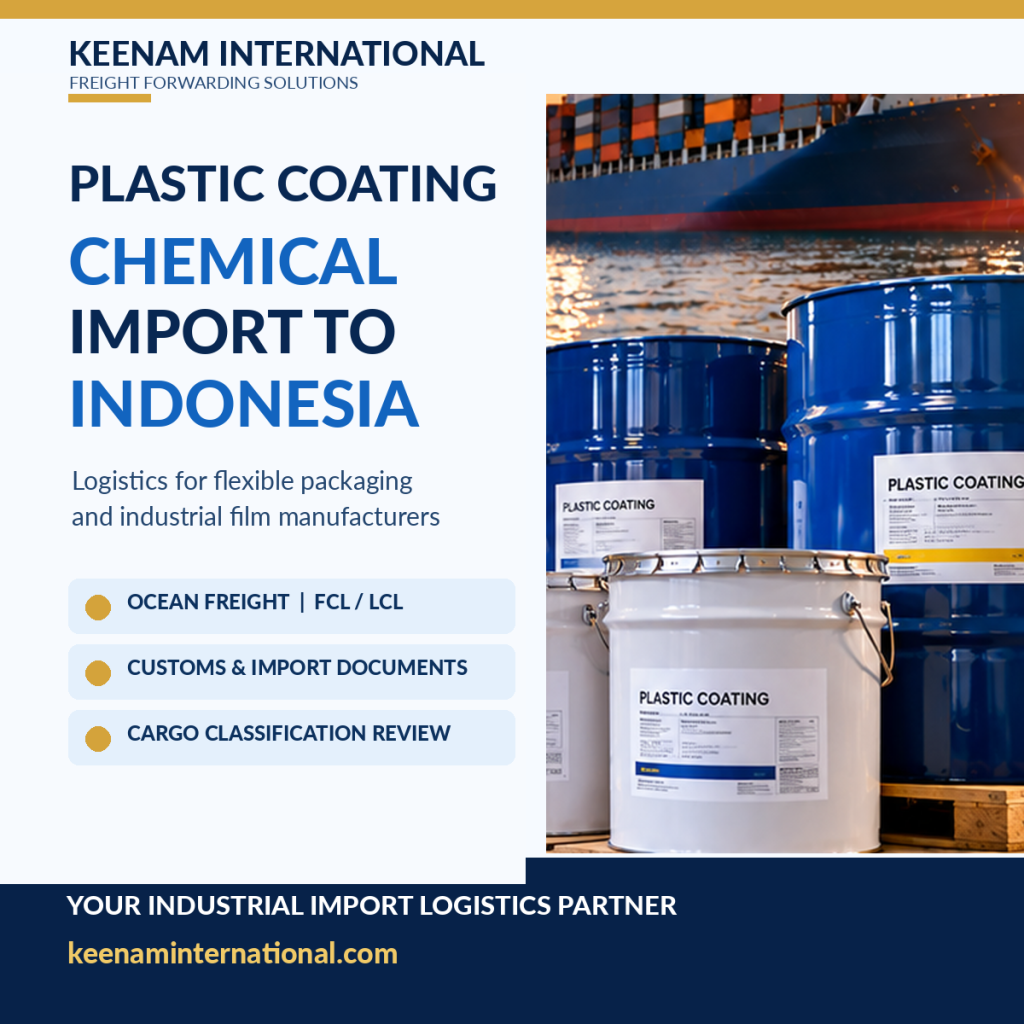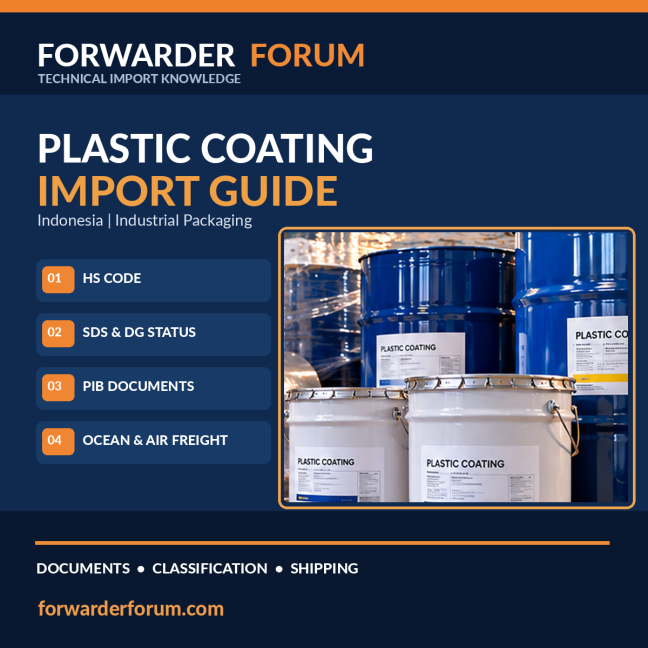
Plastic Coating Chemical Import Guide: HS Codes, SDS and Shipping
Industrial coatings are used in a wide range of manufacturing processes, including flexible packaging conversion, plastic film processing, surface finishing, and industrial printing.
However, shipping coating materials internationally can involve more than preparing a commercial invoice and booking a container.
Different coating formulations can have different chemical properties, customs classifications, storage conditions, and transport requirements.
For importers bringing these products into Indonesia, the most important preparation begins with understanding exactly what is being shipped.
This plastic coating chemical import guide explains essential steps for classifying products, checking documentation, assessing dangerous goods requirements, and planning international freight.
1. Identify the Actual Coating Product
The term “chemical coating” is broad.
It can describe a finished coating preparation, a surface primer, a functional barrier coating, a varnish, or a component used in a coating formulation.
Before considering the shipping method, determine the product’s actual nature.
Examples of materials used in plastics and packaging include:
Water-Based Coatings
Products formulated with water as the primary carrying medium.
They may be used for specific surface and packaging applications depending on their polymer system and functional ingredients.
Solvent-Based Coatings
Products that use organic solvents to support application, drying, or other process characteristics.
Some formulations can be flammable and require additional transport controls.
UV-Curable Coatings
Products designed to cure through a suitable ultraviolet exposure process.
These may contain components whose hazard characteristics require specific assessment.
Primers
Preparations used to improve the adhesion of subsequent layers on plastic film or other substrates.
Barrier Coatings
Functional layers intended to limit the transmission of selected gases or moisture.
Heat-Seal Coatings
Products designed to support sealing performance in particular packaging structures.
Important: These names describe industrial functions and do not independently determine customs or dangerous goods classification.
2. Distinguish Coatings from Adhesives and Chemical Raw Materials
One common source of confusion is the use of commercial names that do not precisely describe the commodity.
A primer, coating, adhesive, resin solution, and industrial thinner may be supplied in similar drums or containers but have different compositions and functions.
For example:
| Product | Main question for classification |
|---|---|
| Finished coating | What is the formulation and applicable tariff description? |
| Primer | Is it a coating, surface treatment, adhesive preparation, or other product? |
| Adhesive | Does the product meet the provisions for a prepared adhesive? |
| Resin solution | What polymers and solvents are present, and in what proportions? |
| Thinner | What is the actual chemical composition and intended function? |
| Coating raw material | Is it an individual substance or a prepared mixture? |
Do not assume that all products sold for the same manufacturing process belong under the same tariff heading.
3. Understanding HS Codes for Chemical Coatings
Chemical coatings should be classified using their actual composition and the applicable tariff provisions.
Two heading families that frequently arise in discussions of polymer-based paints and varnishes are HS 3208 and HS 3209.
HS 3208
Heading 3208 covers certain paints and varnishes based on synthetic polymers or chemically modified natural polymers that are dispersed or dissolved in a non-aqueous medium, as well as particular solutions covered by the legal provisions.
HS 3209
Heading 3209 covers certain paints and varnishes based on synthetic or chemically modified natural polymers dispersed or dissolved in an aqueous medium.
What About Other Coating Preparations?
A material described commercially as a coating may not meet the conditions of either heading.
Other headings may be relevant for adhesives, chemical preparations, surface treatments, or individual chemical substances.
An importer should therefore check:
- The chemical composition.
- Whether the product is a preparation or individual substance.
- The primary product characteristics.
- Its actual function and formulation.
- The relevant legal tariff description.
- The supporting manufacturer documentation.
HS 3208 and 3209 are classification references, not automatic codes for every solvent-based or water-based coating.
For Indonesia, verify the current tariff classification and any associated import restrictions through official resources:
4. Why Safety Data Sheets Matter
A Safety Data Sheet (SDS) contains important information about a chemical substance or mixture.
It can help importers and logistics providers evaluate the material’s hazards and handling requirements.
Relevant information may include:
- Product identification.
- Hazard classification.
- Composition and ingredient information.
- Physical and chemical properties.
- Handling and storage recommendations.
- Firefighting measures.
- Transport classification.
- Special precautions.
Review SDS Section 14
In standard SDS formats, Section 14 addresses transport information.
It may identify a relevant UN number, proper shipping name, transport class, packing group, environmental hazards, and other applicable requirements.
If this information is missing or inconsistent with the actual product, the supplier should be asked for clarification.
An SDS is valuable, but it does not automatically replace the need to verify the legally applicable customs or transportation classification.
5. Dangerous Goods: UN 1139 and Other Possibilities
Some liquid coating materials may meet the criteria for dangerous goods.
The IMDG Code includes the entry:
UN 1139 — Coating Solution
This entry is associated with Class 3 for products meeting the applicable classification requirements.
Other transport entries, such as certain paint-related materials under UN 1263, may be relevant to different formulations.
However, the product’s commercial description cannot determine which entry is correct.
Importers should establish:
- Whether the material is dangerous goods.
- The appropriate UN number, if applicable.
- Proper shipping name.
- Hazard class.
- Packing group.
- Applicable environmental hazard information.
- Required packaging and marking.
- Carrier acceptance conditions.
Not every coating product is a dangerous goods shipment.
Likewise, identifying a product as water-based does not automatically prove that it has no transport hazards.
6. Sea Freight: FCL or LCL?
Full Container Load
FCL may provide a practical arrangement for larger shipments or cargo requiring a dedicated loading plan.
Before loading, review:
- Package compatibility.
- Cargo stability.
- Container condition.
- Applicable segregation requirements.
- Gross weight and load distribution.
- Dangerous goods acceptance where applicable.
Less than Container Load
LCL may be appropriate for smaller shipments when the consolidator accepts the product.
Not every consolidator handles all dangerous goods classes.
For regulated cargo, the shipment may require a different consolidation arrangement or transportation method.
The decision should be made before goods are delivered to the origin facility.
7. Air Freight for Coating Chemicals
Air freight may be useful for samples, development batches, and urgent production materials.
However, certain chemicals are subject to restrictions or specific quantity and packaging conditions.
Product acceptance must be assessed against the applicable air dangerous goods requirements and the relevant airline’s policies.
It is incorrect to assume that a product approved for sea freight can automatically be shipped by air under identical conditions.
8. Checking Drums, Pails and IBCs Before Shipping
Coating chemicals may be supplied in industrial containers such as pails, drums, jerrycans, or IBCs.
The chosen packaging must be compatible with the product and suitable for the planned transportation.
Container and Closure Integrity
Check the condition of the package and confirm that closures are properly secured.
Product Identification
Each package should be identifiable through the relevant labels, markings, and documentation.
Leakage Protection
Packaging arrangements should reduce the risk of unintended leakage or spillage during normal handling and transport.
Dangerous Goods Packaging
Where dangerous goods provisions apply, packaging must meet the relevant requirements, including applicable testing, markings, and package limits.
Cargo Securing
Containers and packages should be loaded and restrained appropriately to prevent shifting or damage.
9. Import Documents Required in Indonesia
The applicable import procedure generally involves customs declarations and supporting documentation.
Common documents include:
Commercial Invoice
Transaction, product, quantity, and value information.
Packing List
Description of the packing units, dimensions, and weights.
Bill of Lading or Air Waybill
Transport documentation appropriate to the shipping mode.
Pemberitahuan Impor Barang (PIB)
The applicable Indonesian customs declaration for importation.
Technical Data Sheet
Product specifications and technical application information.
Safety Data Sheet
Safety and transport information.
Certificate of Analysis
Relevant product or batch data where required.
Certificate of Origin
When applicable to the import transaction or origin treatment.
Dangerous Goods Declaration
Where required for the actual shipment classification.
Other import approvals, permits, or documentation must be determined using the final HS classification and current Indonesian requirements.
10. Understanding the Total Import Cost
Importers should compare freight quotations using the complete logistics scope.
Potential charges may include:
- Product cost.
- Main international freight.
- Insurance, depending on the commercial arrangement.
- Origin handling.
- Destination handling.
- Dangerous goods-related fees, where applicable.
- Customs-related services.
- Applicable duties and taxes.
- Storage or delay-related charges.
- Inland transportation.
The applicable Incoterms rule should be clearly documented so the buyer and seller understand their responsibilities.
11. Common Mistakes When Importing Coating Chemicals
Mistake 1 — Using Only the Product Trade Name
A trade name alone may not provide sufficient information for customs classification.
Better approach: obtain the manufacturer’s technical description and relevant composition data.
Mistake 2 — Assigning HS 3208 to Every Solvent-Based Product
Not all solvent-based preparations qualify under that heading.
Better approach: review the tariff language and actual formulation.
Mistake 3 — Assuming Every Water-Based Coating Is Non-Dangerous
Water-based describes the formulation system but does not independently establish transport classification.
Better approach: review the specific SDS and applicable transport criteria.
Mistake 4 — Booking Freight Without Carrier Acceptance
Some cargo requires dangerous goods procedures or may not be accepted through a particular service.
Better approach: obtain classification and carrier confirmation before dispatch.
Mistake 5 — Ignoring Factory Receiving Requirements
Industrial chemical delivery can require specific unloading procedures, storage conditions, and receiving schedules.
Better approach: coordinate the destination arrangements early.
12. Plastic Coating Chemical Import Checklist
Product Information
- Product name and supplier confirmed.
- Coating formulation identified.
- Chemical description available.
- TDS obtained.
- SDS obtained where applicable.
- Packaging and net quantity verified.
Customs Compliance
- HS Code reviewed.
- Indonesian import restrictions checked.
- Importer requirements verified.
- Invoice prepared.
- Packing list completed.
- PIB coordination established.
- Additional permits identified where required.
Shipping and Safety
- Dangerous goods classification assessed.
- UN number confirmed if applicable.
- Packaging requirements checked.
- Carrier acceptance confirmed.
- FCL, LCL, or air freight feasibility reviewed.
- Handling and storage conditions verified.
- Delivery responsibilities agreed.
Arrival and Delivery
- Customs release arrangements confirmed.
- Destination handling requirements checked.
- Trucking arrangements planned.
- Factory receiving schedule confirmed.
- Cargo inspection procedure prepared.
13. Working with a Freight Forwarder
Freight forwarders support the coordination of international transport and related logistics services.
For industrial chemical imports, early consultation is valuable when a shipment has specific handling or documentation requirements.
The importer remains responsible for ensuring that the applicable legal obligations are met, while the forwarder’s role must be clearly established in the agreed service scope.
Keenam International, a Jakarta-based freight forwarding company established in 1993, provides international shipping and import logistics services for industrial materials.
Businesses can contact the company with their product details, TDS/SDS, packaging information, origin, and destination to discuss available freight arrangements.
Frequently Asked Questions
Is UN 1139 mandatory for all coating solutions?
No. It applies only to products meeting the relevant transport classification requirements.
Does all water-based coating fall under HS 3209?
No. Classification depends on whether the actual product meets the relevant tariff provisions.
Can chemical coatings be imported using LCL?
Potentially, subject to the nature of the cargo and the consolidator’s acceptance requirements.
What is the difference between TDS and SDS?
A TDS explains technical product characteristics, whereas an SDS provides safety and hazard information.
Can coatings be shipped by air?
Some products can be, but acceptance depends on the actual classification and relevant air transport restrictions.
Who is responsible for the accuracy of the import declaration?
The legal responsibilities of importers and authorized representatives are governed by the applicable customs rules.
Conclusion
Plastic coating chemical imports require careful coordination between product manufacturers, importers, freight forwarders, and the receiving industrial facility.
The most important preparation steps are accurate product identification, proper HS classification, reliable safety information, suitable packaging, and confirmation of carrier acceptance.
By reviewing these factors before shipment booking, importers can make more informed decisions and reduce avoidable operational uncertainty.
Freight Forwarding Contact — Keenam International
For industrial chemical coating import inquiries, contact Keenam International.
Office Address
Rukan Lokasari Plaza Blok A No 11
Jalan Mangga Besar Raya No. 81
West Jakarta 11170
Indonesia
Contact Numbers
- Phone: +62-21-6010183 / 6498456
- Fax: +62-21-6003261
- WhatsApp: https://wa.me/6285282767649
- Email: KeenamInternational@gmail.com
Online Presence
- International Website: https://keenaminternational.com
- Indonesian Website: https://keenam.co.id
- Instagram: https://www.instagram.com/keenamid
- YouTube: https://www.youtube.com/@keenaminternational
Forwarder Forum provides educational logistics information. Actual customs classification, safety documentation, and transport requirements must be verified for each product and shipment.